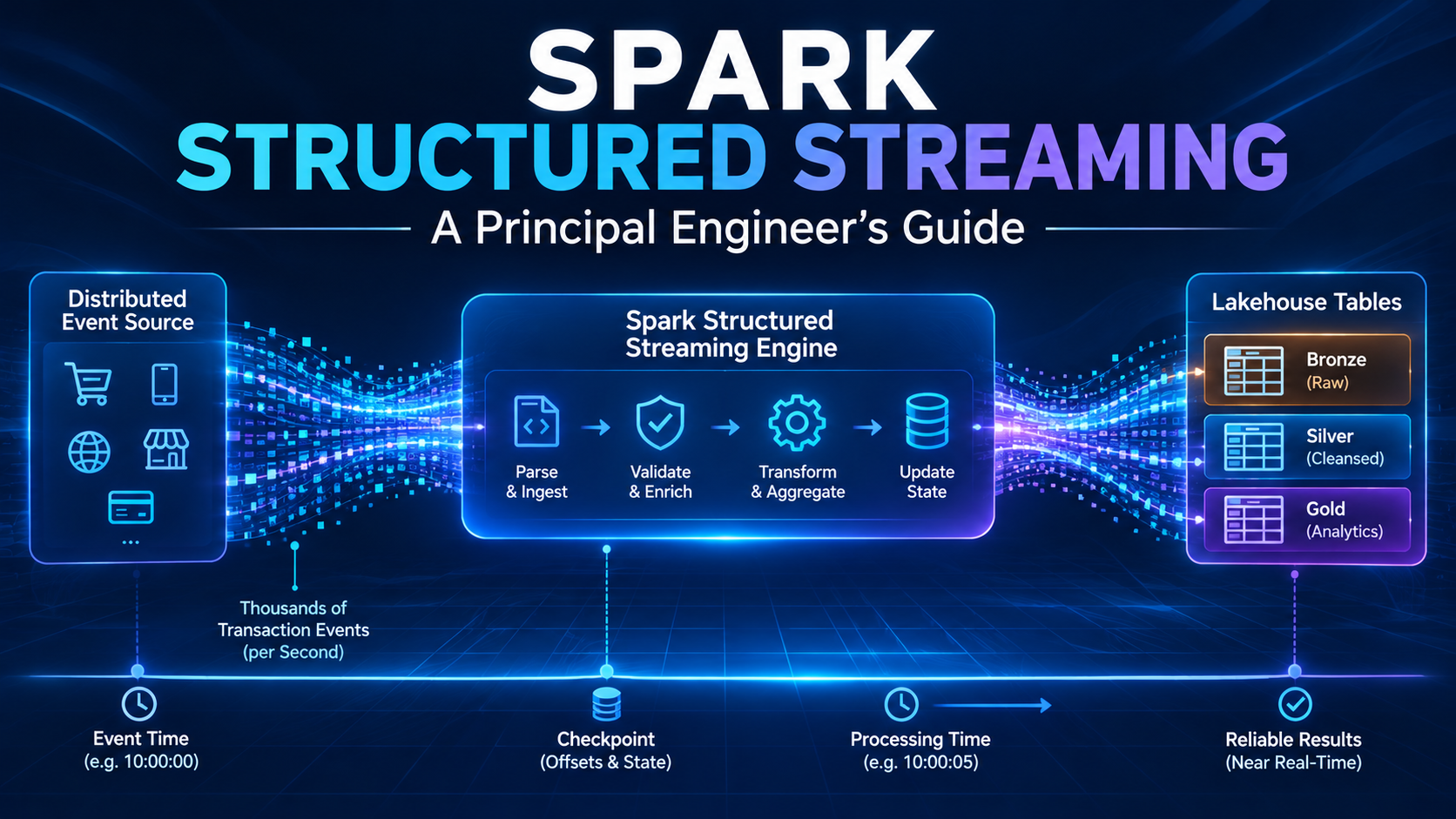
Project Tungsten in Spark: The Performance Work Happening Under the Hood
Spark can distribute your workload across hundreds of machines. But if every row wastes CPU cycles and memory, congratulations — you've distributed the inefficiency. Let's talk about Project Tungsten. If you've worked with Spark long enough, you've probably heard the usual performance advice: Use DataFrames instead of writing everything with RDDs. Avoid Python UDFs when built-in Spark SQL functions can do the job. Watch your shuffles. Tune executor memory. Check the Spark UI before randomly changing configurations. All good advice. But there's a deeper question hiding underneath it. Why can Spark SQL execute the same kind of data processing more efficiently than a straightforward implementation that creates and manipulates millions of JVM objects? That question takes us to Project Tungsten. And if you're preparing for Senior Data Engineer, Lead Data Engineer, or Staff Engineer interviews, this is one of those topics worth understanding properly. Not because an interviewer might ask you to define UnsafeRow — although they might — but because Tungsten connects several important concepts: JVM memory, garbage collection, CPU efficiency, code generation, cache locality, and physical execution plans. These concepts explain why some Spark jobs fly while others turn your cluster into a very expensive space heater. Let's get into it.

1. First, what exactly is Project Tungsten?
Project Tungsten was an Apache Spark initiative focused on improving the efficiency of Spark's execution engine, particularly its CPU and memory usage.
Its key ideas included:
More efficient binary representation of data.
Better control over execution memory.
Cache-aware data structures and processing.
Runtime code generation to reduce per-row processing overhead.
The improvements were introduced incrementally across Spark releases and became an important part of Spark SQL's execution architecture.
Here's the distinction I want you to remember:
Tungsten is not a separate engine that you install. It's a collection of execution-engine improvements integrated into Spark.
You don't enable a magical spark.tungsten.enabled setting in modern Spark and suddenly make every job faster.
Instead, Spark SQL uses applicable optimizations as it plans and executes supported operations.
The exact execution path depends on the Spark version, query plan, data types, operators, and runtime configuration.
Why was Tungsten needed?
Because distributing computation doesn't automatically make the computation itself efficient.
Imagine processing hundreds of millions of transaction records.
For each record, your engine might need to read fields, evaluate conditions, perform arithmetic, compare keys, and construct output.
If those operations repeatedly create JVM objects, call methods through layers of iterators, and generate unnecessary garbage, the overhead becomes substantial.
The problem isn't necessarily that Spark lacks enough machines.
The problem might be how much work each machine performs to process every individual record.
Tungsten targeted that layer of the problem.
And that brings us to the part that makes this topic genuinely interesting.
2. Before Tungsten: The hidden cost of JVM objects
Java and the JVM are powerful. Automatic memory management is one of their biggest advantages.
But automatic memory management doesn't mean memory is free.
Consider a simplified representation of a transaction:
transaction_id = 987654
account_id     = 12345
amount         = 250.75
currency       = "INR"
A conventional object-heavy implementation may represent data through objects, references, wrappers, and nested structures.
Those objects have overhead beyond their actual business values.
For example, a boxed integer is not simply four bytes sitting somewhere in memory. It is a JVM object with object-layout overhead, alignment, and references wherever it is stored inside other structures.
The exact size depends on the JVM, object layout, and data representation.
Now multiply the overhead across millions or billions of records.
The memory consumed by the representation can become much larger than the actual business data.
The garbage collection problem
When an application creates large numbers of short-lived objects, the garbage collector must identify and reclaim objects that are no longer needed.
Garbage collection is necessary. It is not inherently bad.
But frequent allocation and collection can consume CPU and introduce pauses or additional work, depending on the collector and workload.
For a large Spark application, that overhead can become a meaningful part of total execution time.
Imagine a transaction-processing job that spends a substantial portion of its CPU time managing temporary objects instead of calculating transaction totals.
That's not the kind of work you want to pay for.
What Tungsten changed
Spark introduced more efficient binary data representations and explicit memory-management techniques for supported execution paths.
Instead of relying exclusively on ordinary JVM object representations for internal row processing, Spark SQL can use compact binary rows and memory-efficient structures.
The objective is to reduce unnecessary object allocation, improve memory efficiency, and make data processing more predictable.
The important nuance: modern Spark still uses JVM objects in many places. Tungsten did not eliminate objects from the entire Spark runtime.
Staff Engineer takeaway: When investigating performance, distinguish the size of the business data from the memory cost of the representation used to process it.
3. UnsafeRow: Why the way data is stored matters
One of the important concepts associated with Tungsten is UnsafeRow.
The name sounds like a warning label.
Fortunately, it's not an invitation to write unsafe application code.
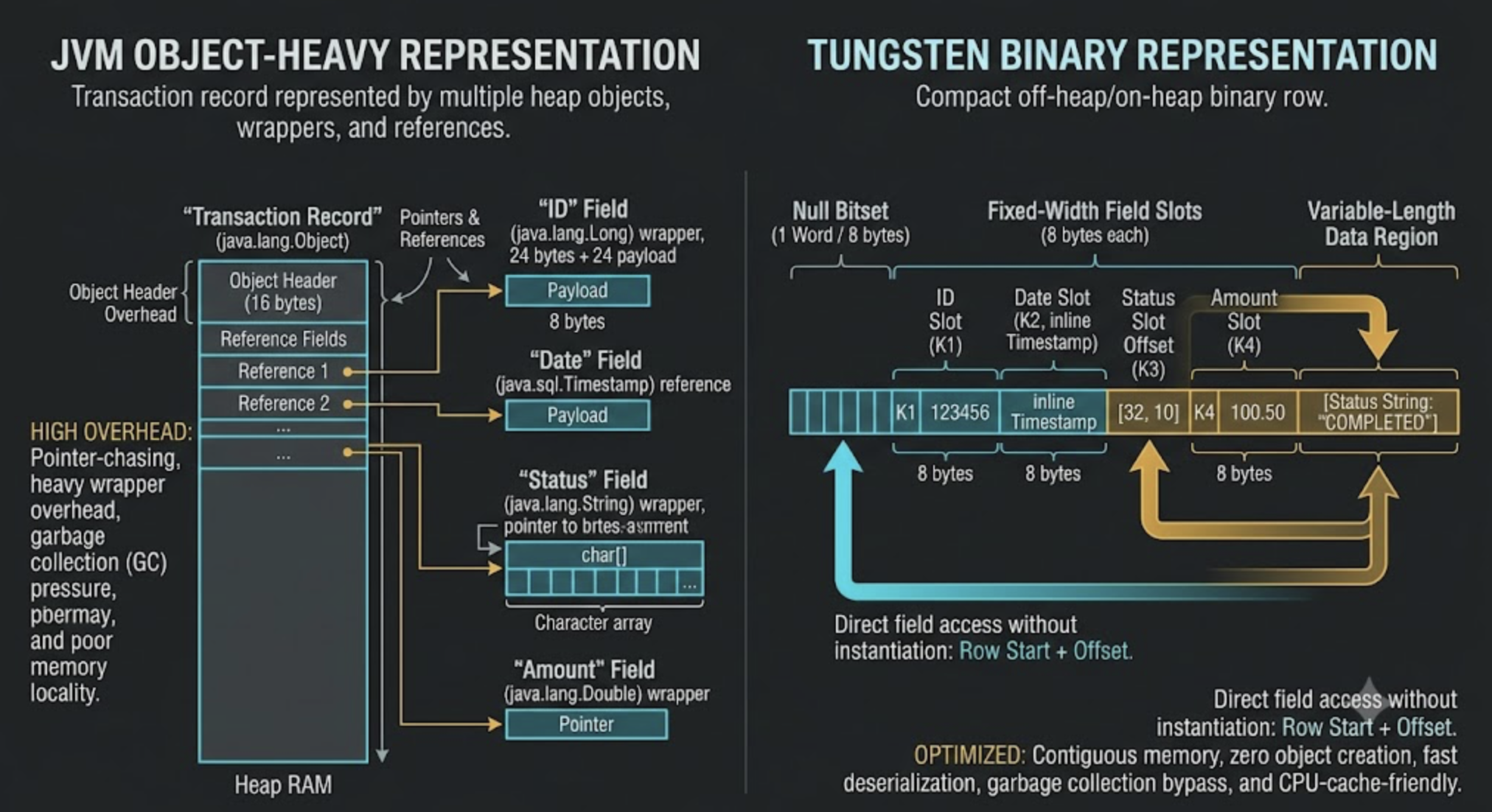
UnsafeRow is an internal Spark SQL row representation designed for efficient access to data stored in a compact binary layout.
Rather than representing every field as an independent JVM object, the row uses a structured byte representation.
Conceptually, an UnsafeRow contains:
A null bitset indicating which fields are null.
Fixed-width slots for fields and references to variable-length data.
A variable-length region for values such as strings and other variable-size data.
The precise layout depends on the schema and Spark's internal representation.
Why is this useful?
Consider a row with three integer-like fields and a string.
With an object-heavy representation, reading the fields can involve following references and accessing separate objects.
With a binary row representation, Spark can access fields using known offsets and the schema's type information.
That can reduce object overhead and simplify the mechanics of field access.
It also makes it easier for Spark's execution machinery to operate on records without repeatedly constructing a separate JVM object for every row.
A conceptual illustration
UnsafeRow
┌──────────────────────────────────────────────┐
│ Null bitset                                  │
├──────────────────────────────────────────────┤
│ Fixed-width slot: transaction_id             │
├──────────────────────────────────────────────┤
│ Fixed-width slot: account_id                 │
├──────────────────────────────────────────────┤
│ Fixed-width slot: amount                     │
├──────────────────────────────────────────────┤
│ Slot/reference: currency offset and length   │
├──────────────────────────────────────────────┤
│ Variable-length data: "INR"                  │
└──────────────────────────────────────────────┘
Illustrative layout, not an exact byte-by-byte specification.
Does UnsafeRow mean all Spark data is stored off-heap?
No.
This is a common misconception, especially in interviews.
UnsafeRow describes a row representation. That representation can be backed by different memory arrangements depending on the execution path.
Spark also uses on-heap and off-heap memory for different purposes, and not every operation follows the same internal path.
The important point is the compact binary representation and efficient access — not the assumption that every Spark row always lives outside the JVM heap.
Why this matters in practice
This becomes relevant when Spark performs operations such as projections, filters, joins, and aggregations through supported SQL execution paths.
Efficient row representation can reduce memory overhead and make internal processing more efficient.
But it doesn't make an expensive shuffle disappear, fix skewed keys, or turn a many-to-many join into a one-to-one join.
Tungsten optimizes the mechanics of processing data. It cannot change the business semantics of your query.
4. Whole-stage code generation: Stop paying for unnecessary method calls
This is my favorite part of the topic because it connects query planning directly to CPU execution.
Consider a simple transformation:
from pyspark.sql import functions as F

result = (
    transactions
    .filter(F.col("amount") > 100)
    .select(
        "account_id",
        (F.col("amount") * 1.18).alias("amount_with_tax")
    )
)
Logically, Spark needs to filter rows and calculate a new value for the surviving records.
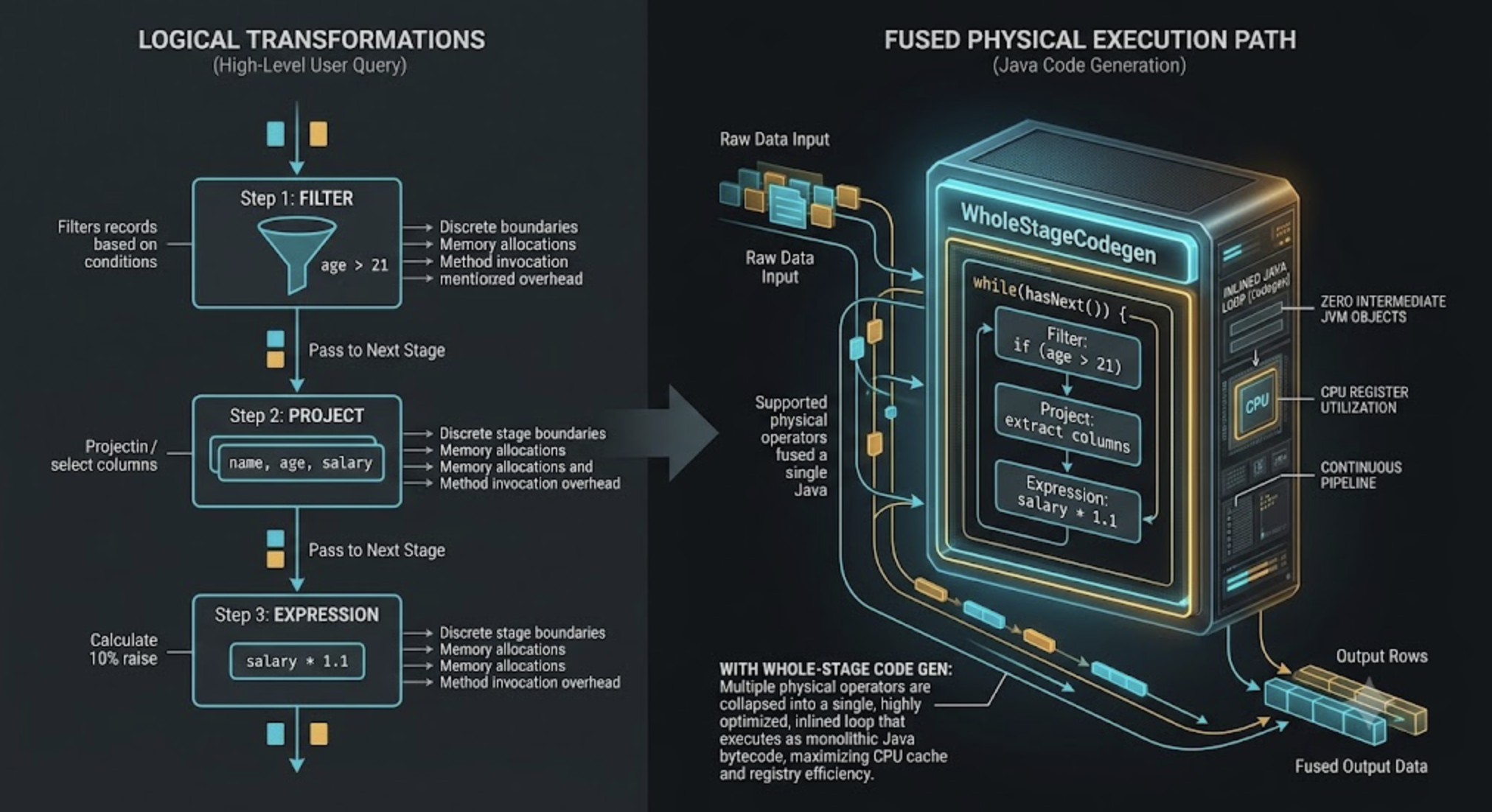
A straightforward execution model might process each operation through separate operator objects, repeatedly moving records through iterator and method-call layers.
That is a simplified conceptual comparison; the details depend on the execution engine and version.
Whole-stage code generation allows Spark SQL to combine supported physical operators into a larger generated Java function.
Instead of treating every supported operation as an isolated unit of execution, Spark can generate code that performs multiple operations in one processing loop.
What does that buy us?
Potential benefits include:
Less per-row virtual method-call overhead.
Fewer intermediate objects for supported execution paths.
Better opportunities for JVM JIT compilation and optimization.
More efficient execution of compatible sequences of operators.
The JVM's Just-In-Time compiler can optimize frequently executed code. Generating a larger, compatible processing path gives it an opportunity to optimize operations together rather than treating every operation as an unrelated step.
The execution flow
Filter → Project → Compute expression
              ↓
       Generated Java code
              ↓
     Execute the fused loop
This is the basic idea behind whole-stage code generation.
It is not the same as compiling your entire PySpark application into native machine code.
Spark generates Java code for supported execution operators, and the JVM compiles and runs that code.
Does every Spark operation get fused?
Absolutely not.
Operator support, physical-plan boundaries, code-generation limits, and the presence of operations that require different execution paths affect what Spark can fuse.
A shuffle is a natural boundary between execution stages. Python UDFs often introduce additional overhead and can interrupt the JVM-side processing path, depending on the UDF type and execution plan.
Some operators also do not support whole-stage code generation.
This is why the correct interview answer is not "Spark compiles everything."
It's:
Spark can fuse supported physical operators into generated code, reducing per-row execution overhead where whole-stage code generation applies.
How do you inspect it?
In PySpark:
result.explain(mode="codegen")
Depending on the query and Spark version, this can show generated code for applicable parts of the physical plan.
You can also inspect the Spark SQL UI and the physical plan for code-generation-related operators.
If you're debugging a job, look at what was actually generated rather than assuming code generation happened just because you're using a DataFrame.
5. Cache locality: Why the CPU cares where your data lives
We've discussed object overhead and code generation. Now let's talk about something that is easy to overlook: the CPU cache.
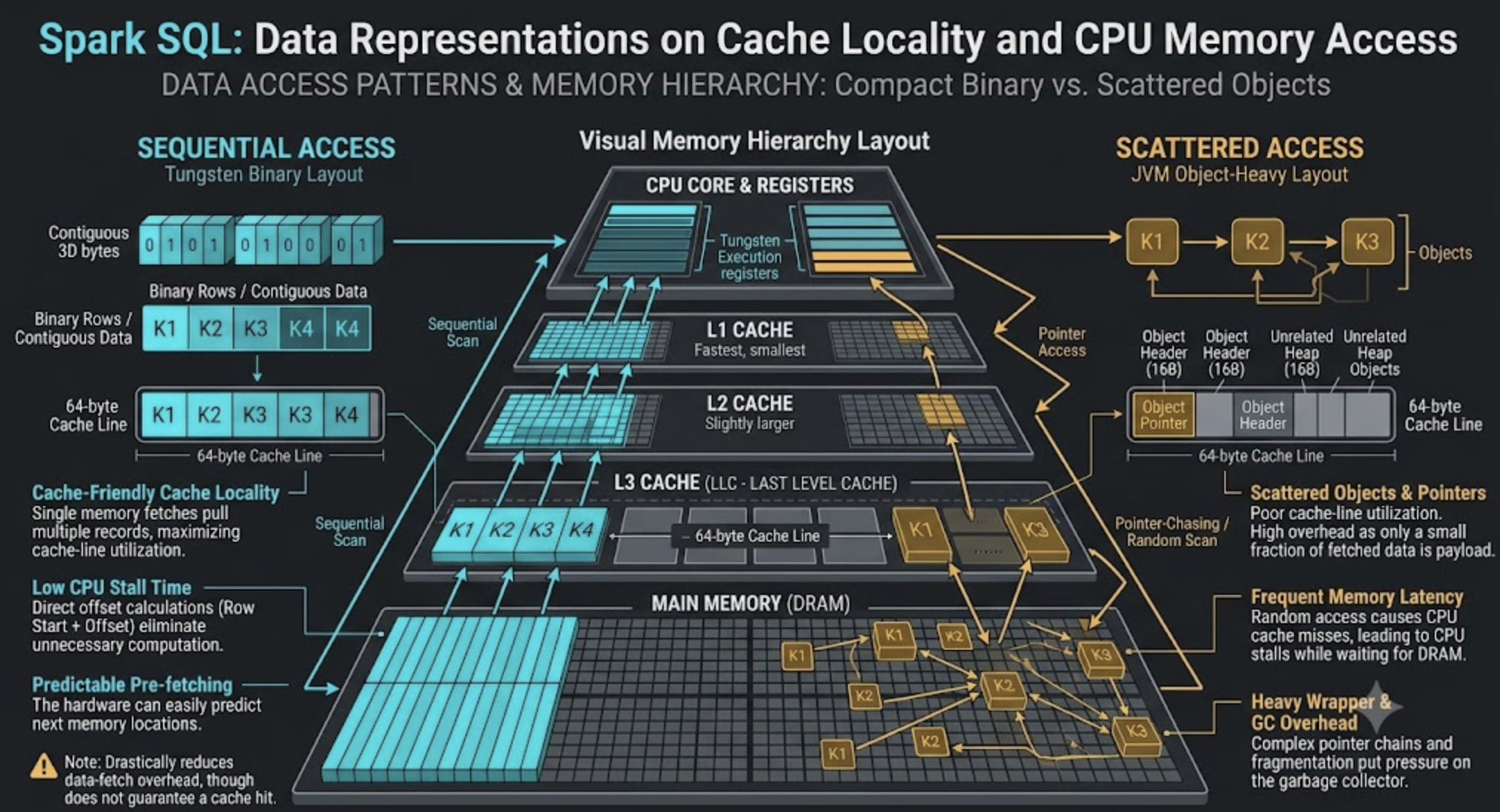
Modern processors use multiple levels of cache to keep frequently accessed data close to the execution units.
Accessing data from a nearby CPU cache is generally much faster than retrieving it from main memory.
When data is laid out predictably and processed in a compatible access pattern, the CPU may make better use of cache lines and hardware prefetching.
When access patterns involve scattered memory locations and pointer chasing, the CPU may spend more time waiting for data.
This is the idea behind cache-aware data structures and processing.
Why binary layouts help
A compact binary representation can make field access more predictable than a representation that requires following multiple object references.
It can also reduce the total memory footprint, potentially improving cache utilization.
But there is an important distinction.
Cache locality is a hardware-level benefit, not a guarantee that every Spark query will become CPU-cache efficient.
Actual behavior depends on the data layout, access pattern, working-set size, generated code, hardware, and execution plan.
What should a Staff Engineer take away?
When analyzing a CPU-bound Spark workload, don't think only about the number of cores.
Think about the work those cores are performing.
Are they spending time on useful calculations? Repeated object allocation? Garbage collection? Inefficient memory access? Expensive expressions? Serialization?
Tungsten addressed several of these efficiency problems through the way Spark SQL represents and processes data.
That's the bigger lesson: adding cores is only one way to improve performance, and it isn't always the right one.
6. Memory management: On-heap versus off-heap
Let's clear up another interview trap.
Off-heap memory is not synonymous with Tungsten, and enabling off-heap memory is not a universal Spark optimization.
Spark has execution and storage memory responsibilities.
Execution memory is used by operations such as joins, sorts, aggregations, and shuffles. Storage memory supports cached and persisted data.
In Spark's unified memory model, execution and storage share a managed region with rules governing how that memory is used.
Spark also supports optional off-heap memory for supported uses.
On-heap memory
On-heap memory is managed as part of the JVM heap.
It is subject to JVM garbage collection. This is convenient and integrates with the normal JVM memory model, but excessive allocation and object-heavy processing can increase GC overhead.
Off-heap memory
Off-heap memory is allocated outside the JVM heap.
For supported execution paths, this can reduce the garbage collector's involvement in managing the underlying data buffers.
However, off-heap memory is still real memory consumed by the process and the machine.
It is not free capacity that exists outside the laws of physics.
A process can exceed its container or host memory limit even when its JVM heap appears healthy.
Should you enable off-heap memory?
Only when you understand the workload and the memory path involved.
I would first inspect:
GC time and frequency.
Executor memory pressure.
Spill to disk.
Task-level execution memory.
Container or process memory usage.
Whether the relevant operations actually benefit from the proposed configuration.
Then I would benchmark a representative workload.
If garbage collection is not a meaningful bottleneck, enabling off-heap memory may provide little benefit while increasing the complexity of memory management.
And if the configuration is wrong, you may simply trade a visible JVM memory problem for a process-level memory failure.
That's not optimization. That's changing the error message.
7. Tungsten vs. Catalyst vs. AQE: Don't confuse the three
These concepts are related, but they solve different problems.
| Concept | Primary responsibility | Example |
|---|---|---|
| Catalyst | Analyze and optimize Spark SQL queries | Push filters down where supported; select a physical plan |
| Tungsten-era execution improvements | Improve the efficiency of supported execution paths | Binary row representation and whole-stage code generation |
| AQE | Adapt eligible execution decisions using runtime statistics | Coalesce shuffle partitions or optimize certain skewed joins |
Catalyst helps determine what Spark should execute.
Tungsten-era improvements help Spark execute supported operations efficiently.
Adaptive Query Execution can revise eligible execution decisions after runtime information becomes available.
These are complementary ideas, not competing engines.
This distinction is particularly important in interviews because it shows that you understand the difference between planning a computation and executing it.
8. A practical example: Investigating an expensive aggregation
Let's say a daily transaction aggregation is slower than expected.
from pyspark.sql import functions as F

daily_summary = (
    spark.table("gold.transactions")
    .filter(F.col("transaction_date") == "2026-10-15")
    .groupBy("account_id")
    .agg(
        F.sum("amount").alias("total_amount")
    )
)

daily_summary.explain(mode="formatted")
Suppose the job is CPU-heavy and slower than expected.
Would I immediately enable off-heap memory? No.
Would I immediately increase executor memory? Also no.
I'd start with the evidence.
Step 1: Inspect the physical plan
Look for the scan, filter, partial aggregation, exchange, and final aggregation operators where applicable.
Confirm whether the plan is doing the work we expect.
Step 2: Check data reduction
Does the date filter reduce the amount of data being processed? Is partition pruning happening if the table layout supports it?
A faster execution engine cannot compensate indefinitely for reading unnecessary data.
Step 3: Check shuffle behavior
Inspect shuffle read and write, partition sizes, and task duration.
If the aggregation has highly skewed keys, one task may receive much more work than the others.
Step 4: Check CPU and memory behavior
Look at CPU utilization, GC time, spill, and execution memory.
If GC overhead is significant, investigate allocation pressure and the execution path. If the job is spending most of its time waiting for shuffle data, Tungsten-related optimizations may not be the primary bottleneck.
Step 5: Check code generation
Inspect the physical plan and generated code for supported operators.
If a hot processing path is not being fused, understand why before trying to force a configuration change.
Step 6: Benchmark the change
Change one relevant variable at a time where possible. Compare equivalent runs and measure end-to-end runtime, resource consumption, and output correctness.
The point of this example is not that Tungsten guarantees a particular speedup.
It's that understanding Tungsten gives you a more complete vocabulary for diagnosing CPU and memory efficiency — alongside the distributed-system costs of scanning, shuffling, and scheduling.
9. What interviewers may ask about Project Tungsten
Q1. What is Project Tungsten in Apache Spark?
Project Tungsten was an initiative to improve Spark execution efficiency, particularly CPU and memory usage. Its key ideas included compact binary data representation, improved memory management, cache-aware processing, and code generation.
Q2. What is UnsafeRow?
UnsafeRow is an internal Spark SQL row representation that stores row data in a compact binary layout. It supports efficient field access and helps reduce the overhead associated with object-heavy row representations.
Q3. What is whole-stage code generation?
It is an optimization that combines supported physical operators into generated Java code so compatible operations can execute together, reducing some per-row overhead.
Q4. Does Tungsten eliminate garbage collection?
No. Spark still runs on the JVM and uses JVM objects in many parts of the runtime. Tungsten-related techniques can reduce object allocation and GC pressure on supported execution paths, but they do not eliminate garbage collection from Spark.
Q5. Does Tungsten mean Spark always uses off-heap memory?
No. Compact binary row representation and off-heap allocation are distinct concepts. Spark can use binary representations backed by different memory arrangements, and off-heap memory is optional for supported use cases.
Q6. What is the difference between Tungsten and Catalyst?
Catalyst is Spark SQL's query optimizer. Tungsten refers to execution-engine improvements intended to make data processing more CPU- and memory-efficient. They work together.
Q7. How do you check whether whole-stage code generation is being used?
Inspect the physical plan and use DataFrame.explain(mode="codegen") where supported. Check the actual generated code and execution plan rather than assuming every operation is fused.
Q8. Why can a Spark job still be slow if Tungsten improves CPU efficiency?
Because CPU efficiency is only one part of distributed execution. Shuffle volume, data skew, I/O, poor partitioning, inefficient joins, source throughput, and scheduling can still dominate runtime.
Q9. Should I enable off-heap memory to improve performance?
Not by default. First identify whether GC or heap pressure is a meaningful bottleneck, then benchmark the relevant configuration with representative data and monitor total process memory.
Q10. What is the Staff Engineer perspective on Tungsten?
Understand which performance costs occur inside record processing and which come from the distributed system around it. Use that distinction to choose the right optimization, establish measurable baselines, and make the diagnosis repeatable for the team.

10. The real Staff Engineer lesson
Here's where I think the discussion gets more interesting than a standard interview answer.
A junior engineer might ask, "What is Tungsten?"
A senior engineer might explain UnsafeRow, code generation, and memory management.
A Staff Engineer should connect those ideas to the workload.
Is the job CPU-bound or shuffle-bound? Are we spending time processing records or moving them around? Is the execution plan taking advantage of the optimizations available to it? Are we creating unnecessary intermediate data? Is GC a significant part of runtime? Will the optimization remain useful as the workload grows?
Those questions connect internal engine knowledge to system design, reliability, and cost.
And that's the difference between knowing Spark terminology and being able to diagnose a distributed workload.
A final note on modern Spark
Tungsten is important historically and technically, but it should not be treated as a standalone feature that you tune independently.
Modern Spark combines query optimization, efficient internal data representations, code generation, memory management, adaptive execution, and other improvements.
On Databricks, Photon is a separate native execution engine that can accelerate supported workloads. It is not simply another name for Tungsten.
Understanding these distinctions helps you reason about the engine you're actually running, rather than applying advice from an old Spark article without checking whether it still applies.
Distributed computing taught us how to divide the work. Tungsten reminds us that we should also stop wasting effort on every piece of it.
Because a thousand executors processing inefficiently are still processing inefficiently.
And the best performance optimization isn't always a bigger cluster.
Sometimes, it's understanding what happens between reading a row and doing something useful with it.
Now that's an optimization worth knowing before your next Spark interview.
#ApacheSpark #SparkInternals #ProjectTungsten #DataEngineering #BigData #JVM #PerformanceOptimization #DistributedSystems #StaffEngineer
About the author
- I am a Lead Data Infrastructure Architect with 13+ years of experience engineering high-throughput data platforms for fintech and consumer apps. I specialize in the Databricks Lakehouse ecosystem, PySpark, BigQuery, and Snowflake. I write about modern data architecture, cloud cost optimization (FinOps), declarative ELT pipelines, and scaling systems to process 100K+ events per second. When I'm not untangling complex legacy databases, I'm building zero-loss data quality frameworks.
Comments
Join the discussionNo comments yet. Be the first to comment.