Databricks Features That Matter: A Staff Engineer's Guide
The platform is evolving fast. Here’s how to separate genuinely useful engineering capabilities from features that look impressive in a demo. There’s a particular kind of excitement in data engineering. A new feature launches. The demo looks fantastic. Someone shares a benchmark. Someone else announces that their architecture is now “AI-native.” Before the week is over, your backlog has acquired another migration project. Meanwhile, the production pipeline is still late, the cloud bill is doing cardio, and Finance has three different definitions of revenue. Welcome to data engineering. Databricks has been evolving well beyond its original identity as a managed Spark platform. Its newer capabilities span data ingestion, declarative pipelines, governance across engines, real-time processing, AI-assisted development, and conversational analytics. The 2025–2026 Lakeflow and Unity Catalog announcements make that direction particularly clear. But the interesting question isn't what has Databricks launched? It's this: Which capabilities change the way we build reliable data platforms, which problems do they actually solve, and when should we deliberately choose not to use them? Let's explore that through a problem most data teams will recognize.
The story: our pipeline is green. Why is the business still unhappy?
Imagine we're building a data platform for a crypto-trading business.
Trade events arrive continuously. Kafka carries market events, while database changes capture orders, deposits, withdrawals, and account activity. Spark processes the data, Delta tables store it on cloud object storage, and downstream dashboards power Finance, Risk, Product, and Operations.
The original architecture works reasonably well.
Then the business grows.
Finance needs consistent revenue numbers across dashboards. Risk wants fresher exposure calculations. Product wants near-real-time token trends. Analysts want to ask questions without waiting for an engineer to write every SQL query. Meanwhile, the platform team is trying to control compute costs and reduce operational toil.
Suddenly, the problems are connected.
A new ingestion tool won't fix inconsistent business definitions. Faster streaming won't fix an incorrect transformation. An AI assistant won't make an undocumented table trustworthy. And moving everything to serverless won't automatically make it cheaper.
This is where the newer Databricks features become interesting—not as isolated product announcements, but as possible answers to real architectural problems.
1. Lakeflow: stop treating every pipeline as a separate engineering project
Let's start with one of the most consequential developments: Lakeflow.
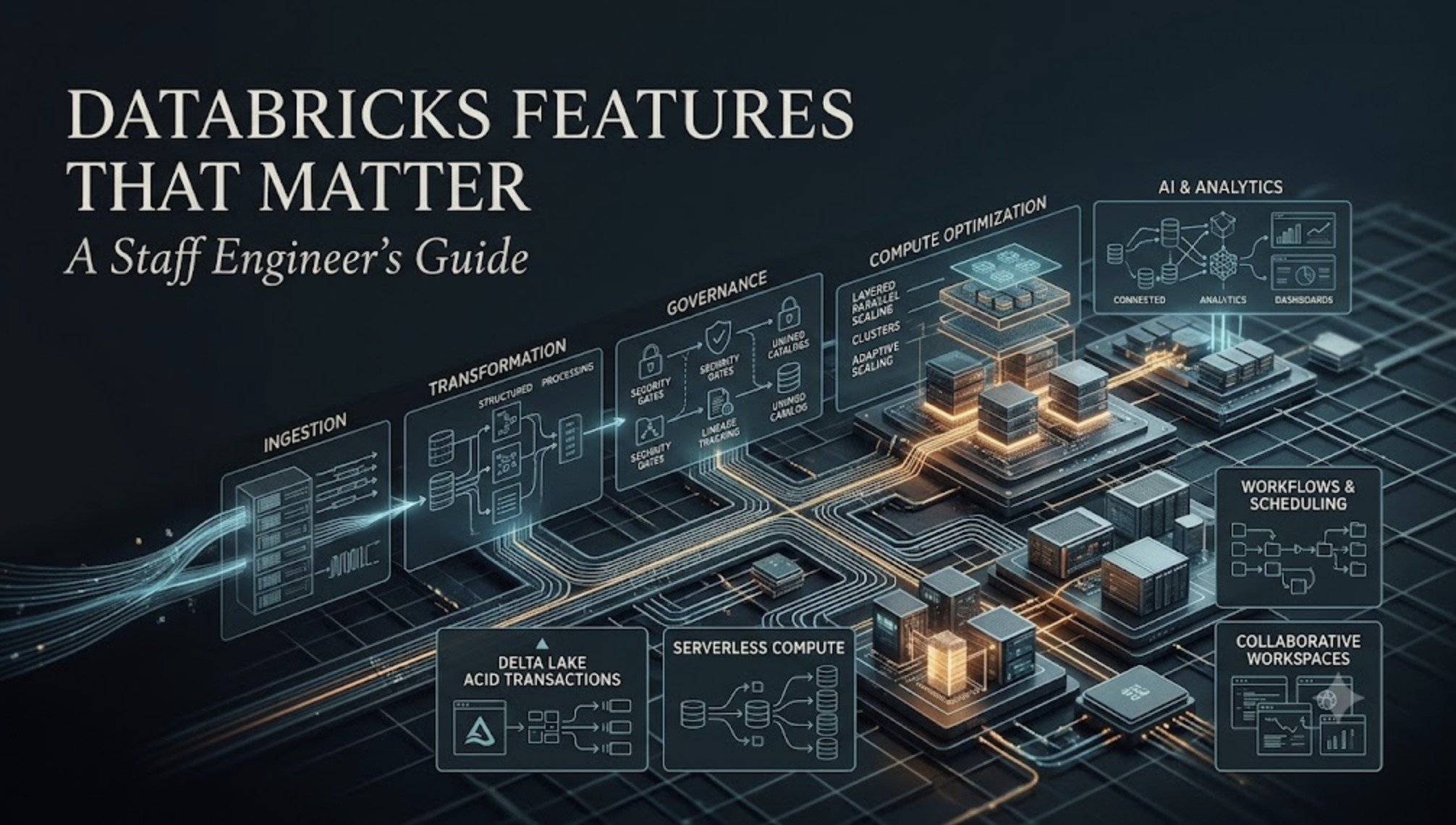
Databricks positions Lakeflow as a unified data engineering solution covering ingestion, transformation, and orchestration. Its components include Lakeflow Connect, Lakeflow Spark Declarative Pipelines, and Lakeflow Jobs. The platform direction is to bring more of the pipeline lifecycle into one governed environment. Official announcement
Why should a Staff Engineer care?
Think about a typical production pipeline.
You might use one service to ingest database changes, another framework to transform data, an external scheduler to orchestrate jobs, separate monitoring to identify failures, and custom scripts to deploy everything.
Each component may work perfectly in isolation. The operational complexity appears between them.
Who owns a failure when ingestion succeeds but transformation doesn't? How do you trace a bad metric back to the source event? How many separate configurations, credentials, deployment mechanisms, and monitoring surfaces must an engineer understand before safely changing the pipeline?
This is the problem Lakeflow attempts to reduce.
It isn't simply about replacing several tools with one vendor's products. It's about reducing the number of boundaries across which engineers must maintain reliability, observability, and governance.
However, consolidation only helps when it reduces total operational complexity. If your existing platform is stable, cost-effective, and well understood, migrating everything just to adopt a unified product suite may create more risk than value.
The Staff Engineer test: Does the new architecture remove operational work, or merely move that work somewhere else?
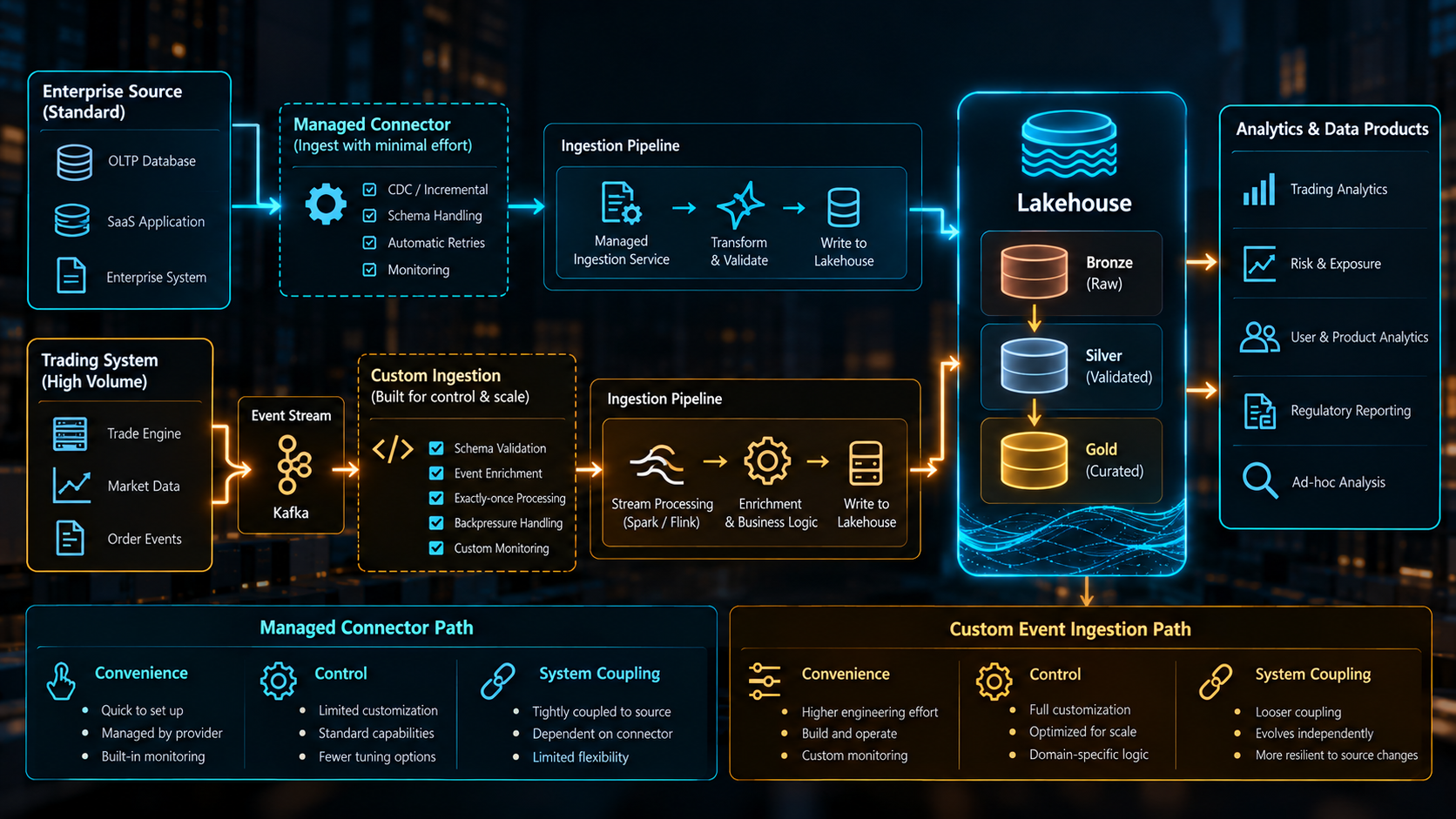
Lakeflow Connect: should we build ingestion or buy it?
Suppose order updates live in a relational database, customer attributes come from a SaaS application, and trading events arrive through Kafka.
Traditionally, the team might build custom ingestion for each source, handling incremental extraction, schema evolution, retries, checkpoints, and failure recovery.
Managed connectors can reduce that engineering burden for supported sources. Lakeflow Connect has been expanding its managed connector ecosystem, including database and enterprise application sources. The exact connector availability and maturity depend on the source and cloud environment. Connector overview
But a managed connector isn't automatically the right answer.
Consider three situations:
| Situation | My architectural preference |
|---|---|
| A supported business application with standard incremental ingestion requirements | Evaluate a managed connector first |
| A proprietary internal service with unusual event semantics | A custom connector may provide better control |
| A high-volume event stream already operating reliably through Kafka | Keep Kafka unless there is a concrete reason to change the ingestion path |
The last case matters. If Kafka already provides buffering, replay, decoupling, and an operational contract between producers and consumers, replacing it simply because another ingestion option exists may be unnecessary.
The real comparison is not “managed versus custom.” It is total cost of ownership, delivery guarantees, latency, operational burden, observability, and the ability to recover safely.
Lakeflow Spark Declarative Pipelines: describe the result, not every operational step
This is the part I find particularly interesting from a data engineering perspective.
Traditional Spark code often makes engineers responsible for explicitly wiring together execution logic, dependencies, and operational behavior. A declarative pipeline lets us express the transformations and relationships between datasets while the framework manages more of the execution lifecycle.
For example, imagine our platform has three logical layers:
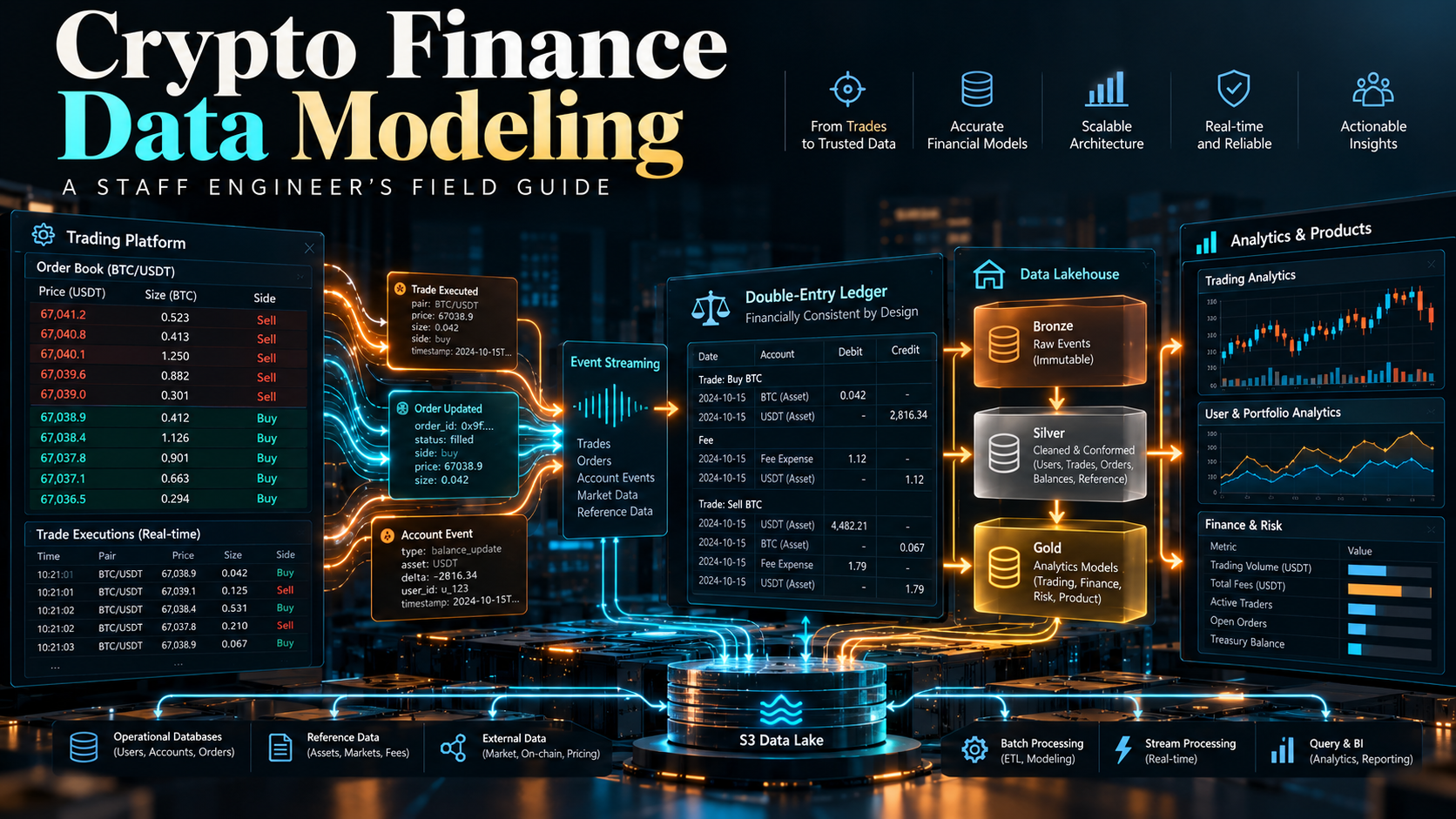
- Bronze: raw trade events, preserved for replay and investigation.
- Silver: validated, deduplicated, and normalized trades.
- Gold: business-ready revenue, volume, and exposure datasets.
A simplified SQL-style illustration of the intent might look like this:
CREATE OR REFRESH STREAMING TABLE silver_trades AS
SELECT
    trade_id,
    account_id,
    token,
    CAST(price AS DECIMAL(20, 8)) AS price,
    CAST(quantity AS DECIMAL(20, 8)) AS quantity,
    event_timestamp
FROM STREAM(bronze_trades)
WHERE trade_id IS NOT NULL;
This is illustrative SQL; exact syntax and supported constructs depend on the pipeline API and runtime version.
The important idea is that the transformation is declared as a dataset in a pipeline, rather than treated only as a standalone script that someone must manually connect to other scripts.
That can simplify dependency management, pipeline development, and operations. Databricks has also introduced a dedicated Lakeflow Pipelines Editor with dependency visualization, previews, execution insights, and Git-oriented development capabilities. Pipeline editor announcement
But declarative doesn't mean magically correct.
You still need to decide what constitutes a valid trade, how to handle late events, what deduplication key is legitimate, and how to recover after a bad deployment. The framework can manage execution; it cannot invent your business semantics.
My rule: Use declarative pipelines when the value of managed dependencies, data quality, and operational lifecycle exceeds the flexibility you gain from hand-wiring everything yourself. Keep custom Spark jobs when their specialized execution behavior genuinely warrants it.
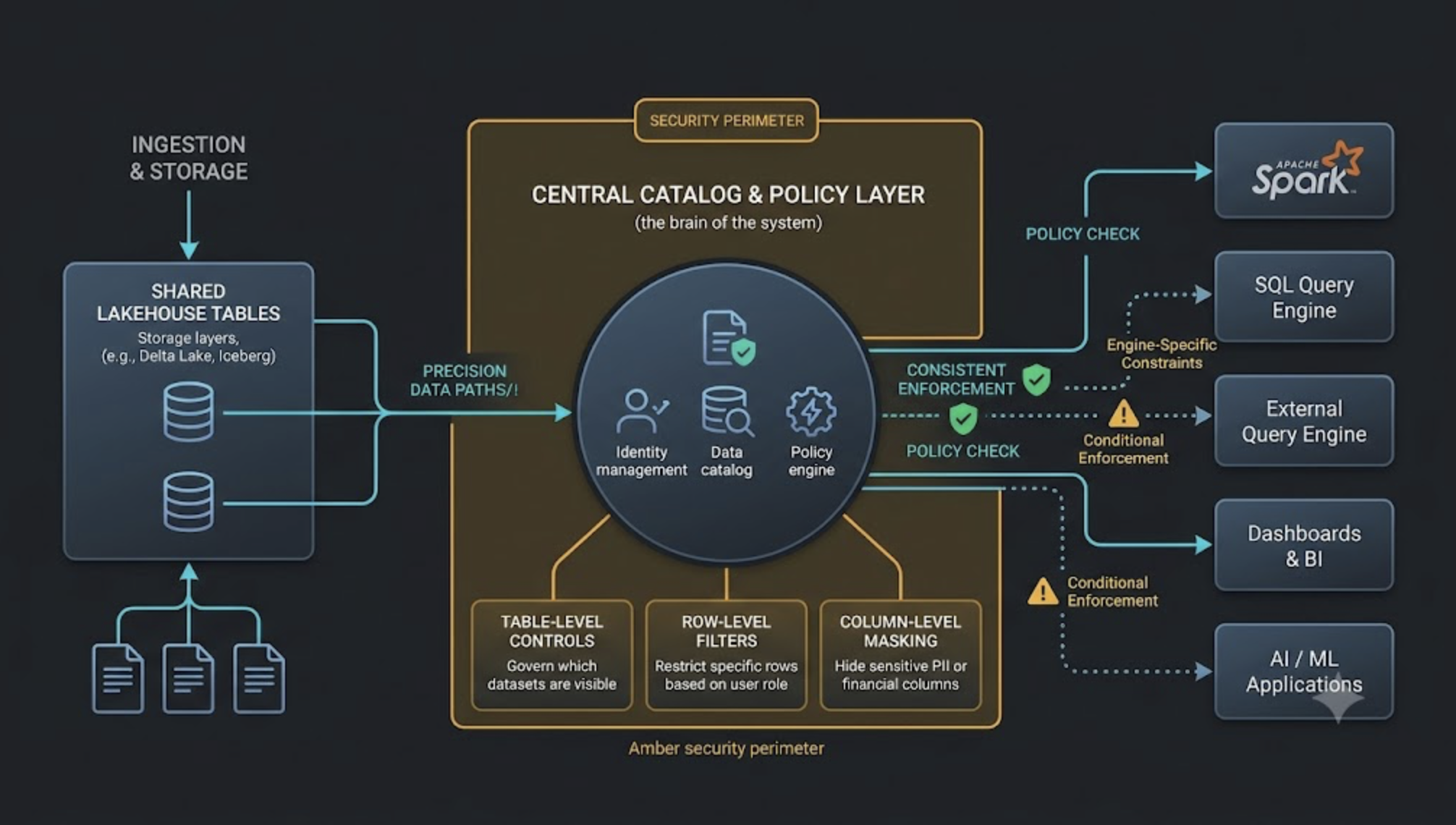
2. Unity Catalog: governance is becoming an architectural decision, not a final checklist
Let's take the revenue problem from our opening story.
Finance calculates revenue from completed trades. Product uses a different transformation that includes additional transaction types. An analytics dashboard applies its own filters. An AI assistant is then connected to the same lakehouse.
Now we have four consumers and potentially four definitions of the same metric.
This isn't primarily a dashboard problem. It's a semantics and governance problem.
Unity Catalog has been expanding beyond table discovery and access permissions toward a common governance layer for data, AI assets, business metrics, and access policies. Its newer direction also includes support for open table formats and broader interoperability with external engines. Unity Catalog updates
Why this matters more than another SQL optimization
A fast query that returns the wrong business number is still wrong.
A perfectly optimized pipeline that exposes sensitive customer information to the wrong audience is still a security failure.
And a model trained on a dataset whose meaning changes every month may quietly become less useful even if its training job never fails.
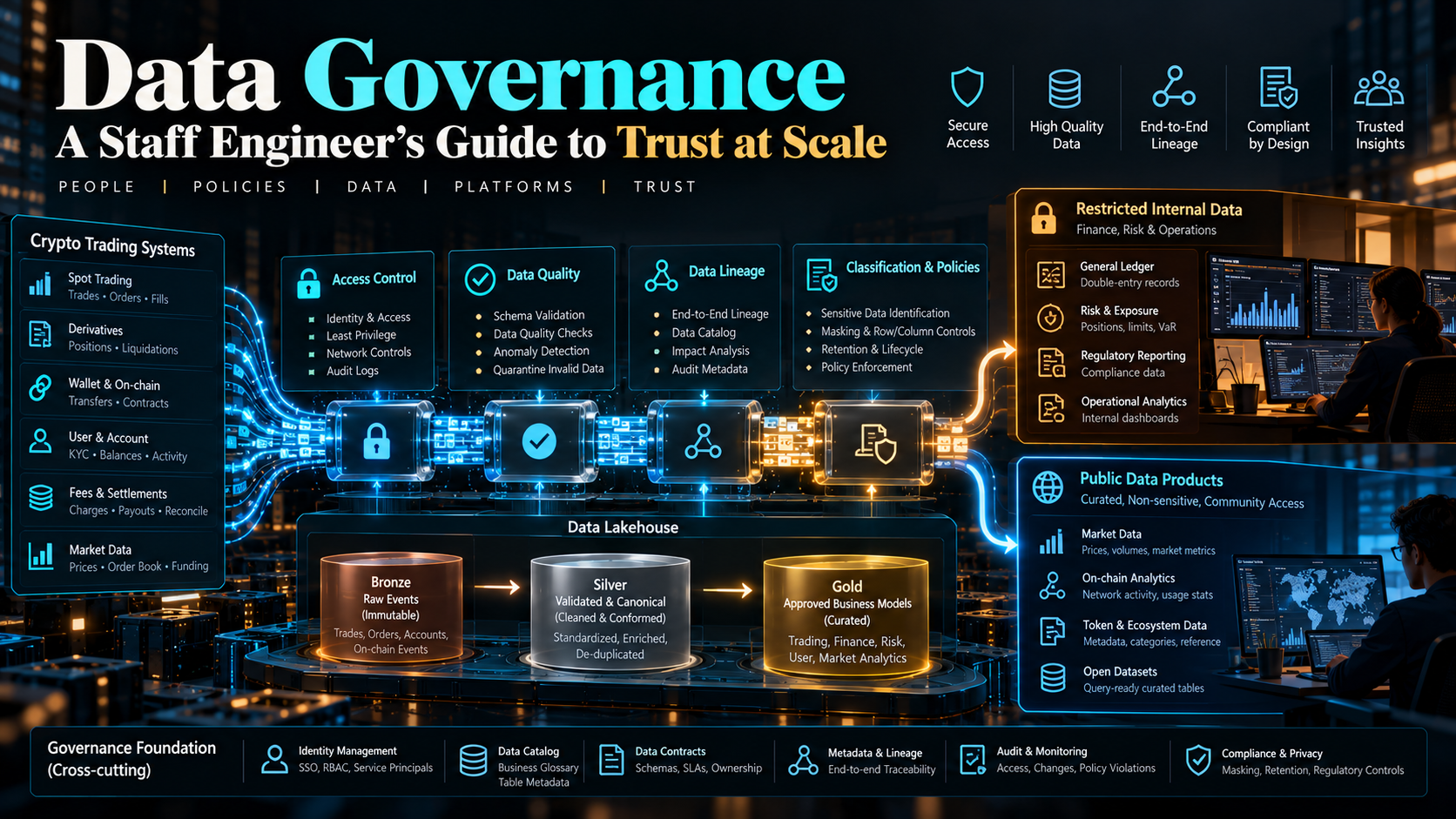
Governance becomes particularly important when multiple teams and tools access the same underlying data. The platform must answer three questions consistently:
- What does this data mean?
- Who is allowed to access it, and at what level of detail?
- Can we trace where it came from and how it was transformed?
Unity Catalog is useful when it helps teams answer those questions through shared controls instead of maintaining disconnected implementations across every consumer.
A practical example: one table, different permissions
Imagine a gold.customer_trades table containing trade activity and customer identifiers.
Finance needs aggregated trading volume. Risk needs account-level exposure. A public analytics dashboard should only see approved, non-sensitive metrics.
Creating three copies of the entire dataset may seem straightforward. But now you must keep the copies consistent, monitor their refreshes, and ensure a new sensitive column doesn't accidentally propagate into a public dataset.
A stronger design is to classify the data, define explicit permissions, apply appropriate row or column controls where supported, and publish a deliberately curated public data product.
Unity Catalog has also been advancing fine-grained access controls across engines, including attribute-based access control (ABAC), row filters, and column masks. The precise capabilities available to an external engine depend on the feature's current support and deployment configuration. Cross-engine governance announcement
That last qualification is important. Never assume that a policy enforced in one query engine automatically protects every other path to the underlying storage. Verify the actual enforcement boundary.
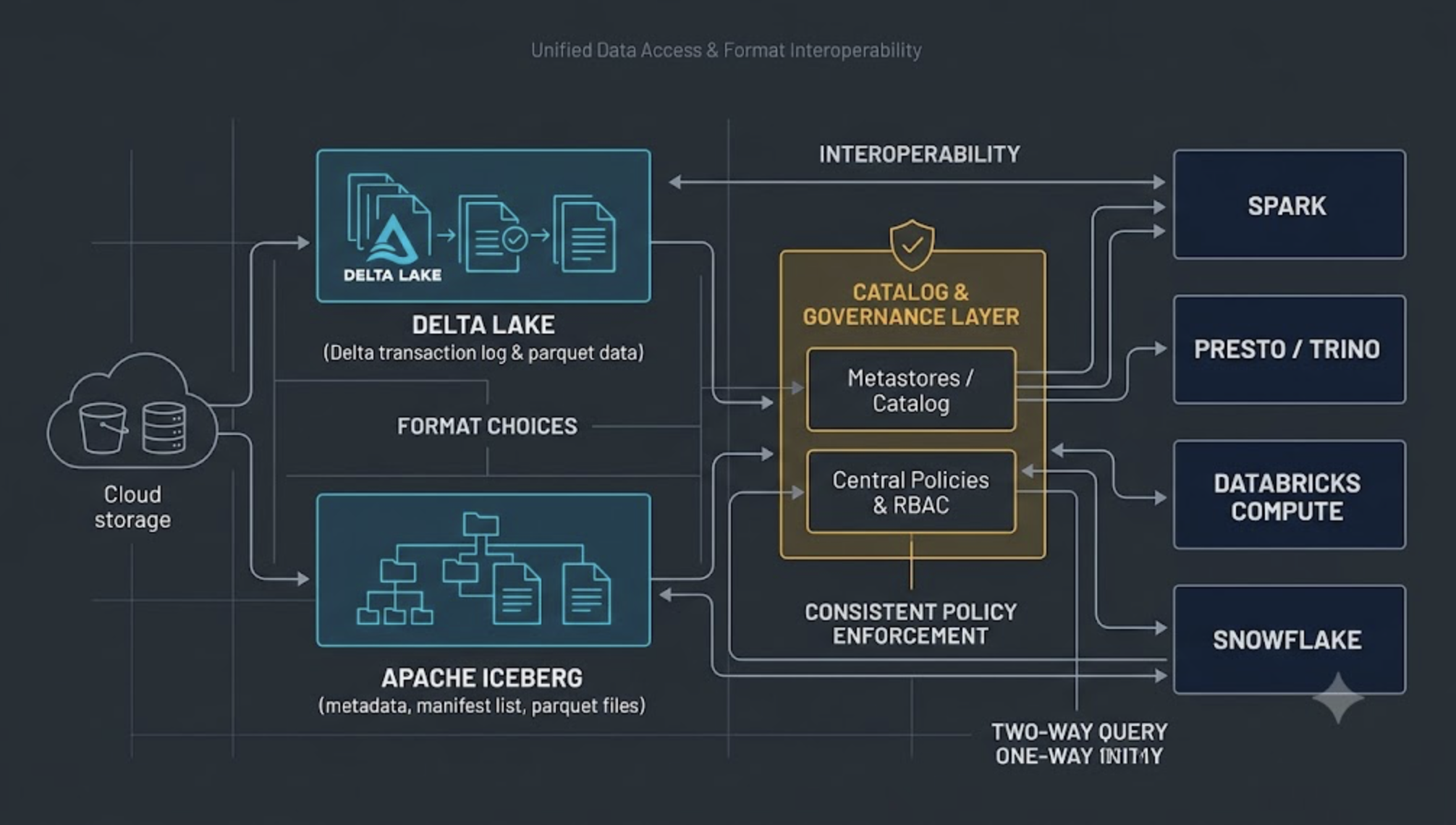
What about Delta Lake versus Apache Iceberg?
This is another decision where a Staff Engineer should resist religious arguments.
Delta Lake and Apache Iceberg are open table formats with different histories, capabilities, and ecosystem trade-offs. The right choice depends on existing workloads, engine compatibility, operational requirements, and future portability needs.
Unity Catalog's expansion into Iceberg and external-engine interoperability makes it increasingly practical to think about governance separately from the specific query engine or table format. Some capabilities have been announced in preview before reaching general availability, so verify the status that applies to your environment.
Here's how I'd evaluate the choice:
| Question | What should drive the decision? |
|---|---|
| Are most workloads already running well on Delta? | Avoid migration without a measurable benefit |
| Must several engines access the same tables? | Test the exact format and catalog interoperability required |
| Do external engines need consistent row- and column-level security? | Validate policy enforcement end to end |
| Is portability a strategic requirement? | Evaluate open formats, catalog APIs, and the practical migration path—not just the format name |
Open formats are valuable. But open storage without consistent governance can create a new security problem: more ways to access the data, with different enforcement behavior.
The lesson: Portability is not just the ability to read a file. It is the ability to use data across systems without losing the guarantees that made the data trustworthy.
3. Real-time processing: when fresher data is worth paying for
Let's return to the trading platform.
Token prices arrive every few seconds. A downstream pipeline currently refreshes every 30 minutes. Product wants trending tokens to update within a minute, and Risk wants exposure calculations to become fresher.
The obvious reaction is to say, “We need real-time streaming.”
Maybe. But let's ask a better question.
What decision becomes materially better if the data arrives sooner?
If a dashboard refreshes every 30 minutes but its users make decisions once per day, reducing the latency to a few seconds may add complexity without meaningful business value.
If Risk uses the output to react to rapidly changing exposure, freshness may be a genuine requirement.
Latency is not a trophy. It's a product and risk requirement.
Micro-batch versus lower-latency processing
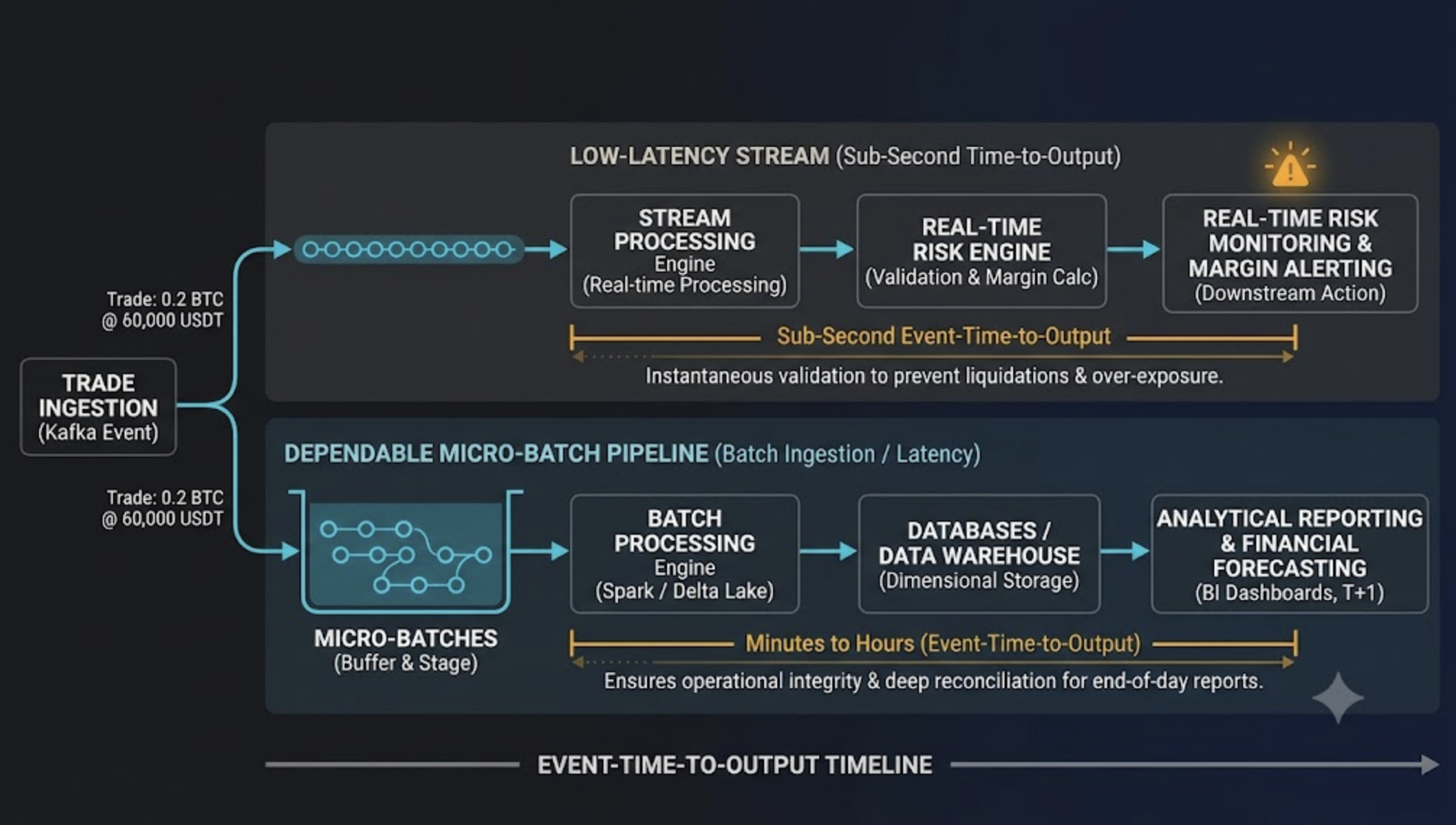
Spark Structured Streaming commonly uses micro-batch processing, where records are processed in small batches. This approach can offer strong throughput, fault tolerance, and manageable operational behavior for many workloads.
Databricks has also been advancing real-time processing capabilities within Lakeflow and Spark Declarative Pipelines. Its 2026 platform direction describes Real-Time Mode as targeting millisecond-level processing latency for supported workloads. That does not mean every Spark workload can be switched to millisecond latency without trade-offs. Lakeflow real-time direction
The architecture should follow the required service level.
| Requirement | Reasonable starting point |
|---|---|
| Daily or hourly reporting | Batch processing |
| Data refreshed every few minutes | Scheduled incremental processing or micro-batch streaming |
| Continuous updates with sub-minute freshness | Streaming, with careful measurement of end-to-end latency |
| Millisecond-sensitive processing | Evaluate specialized real-time capabilities and validate the full path |
The phrase end-to-end is doing a lot of work here.
A pipeline may process each micro-batch in two seconds while the data itself spent 20 seconds waiting upstream. The transformation engine is fast, but the business still sees stale information.
Measure event time to usable output, not just execution duration.
Where Zerobus fits—and where it doesn't
Zerobus Ingest is another capability worth understanding. Databricks describes it as a way for producers to write data directly into the platform without requiring Kafka as the ingestion intermediary for that particular path. It targets use cases that benefit from a direct ingestion interface and low latency. Lakeflow and Zerobus overview
That sounds attractive, especially when a team wants to simplify an ingestion stack.
But consider a platform that already uses Kafka to decouple trading services from downstream consumers. Kafka may serve multiple consumers, retain events for replay, and absorb bursts independently of the analytics platform.
Replacing that path could remove infrastructure, but it could also remove useful architectural properties.
I would evaluate Zerobus for a direct-ingestion use case when its latency, throughput, reliability, and consumer model match the requirement. I would not replace an established Kafka architecture without comparing replay requirements, fan-out, producer coupling, failure behavior, and cost.
The question isn't whether one technology is newer.
It's whether the new design preserves the guarantees the business depends on.
4. Serverless and performance optimization: the fastest way to waste money is to optimize the wrong thing
Cloud cost conversations often begin with compute.
A Spark job is slow, so someone increases the cluster size. A dashboard is sluggish, so someone increases the SQL warehouse. A workload runs all day, so someone switches to serverless because it sounds simpler.
Sometimes these are correct decisions. Sometimes we have just paid more money to avoid understanding the problem.
Serverless: buy less infrastructure work, not automatically less compute
Serverless can reduce infrastructure management and simplify how workloads are provisioned and run. Depending on the workload and supported features, it can be a strong choice for variable demand, interactive workloads, and managed pipeline execution.
But serverless does not mean costless, and it does not guarantee the lowest bill.
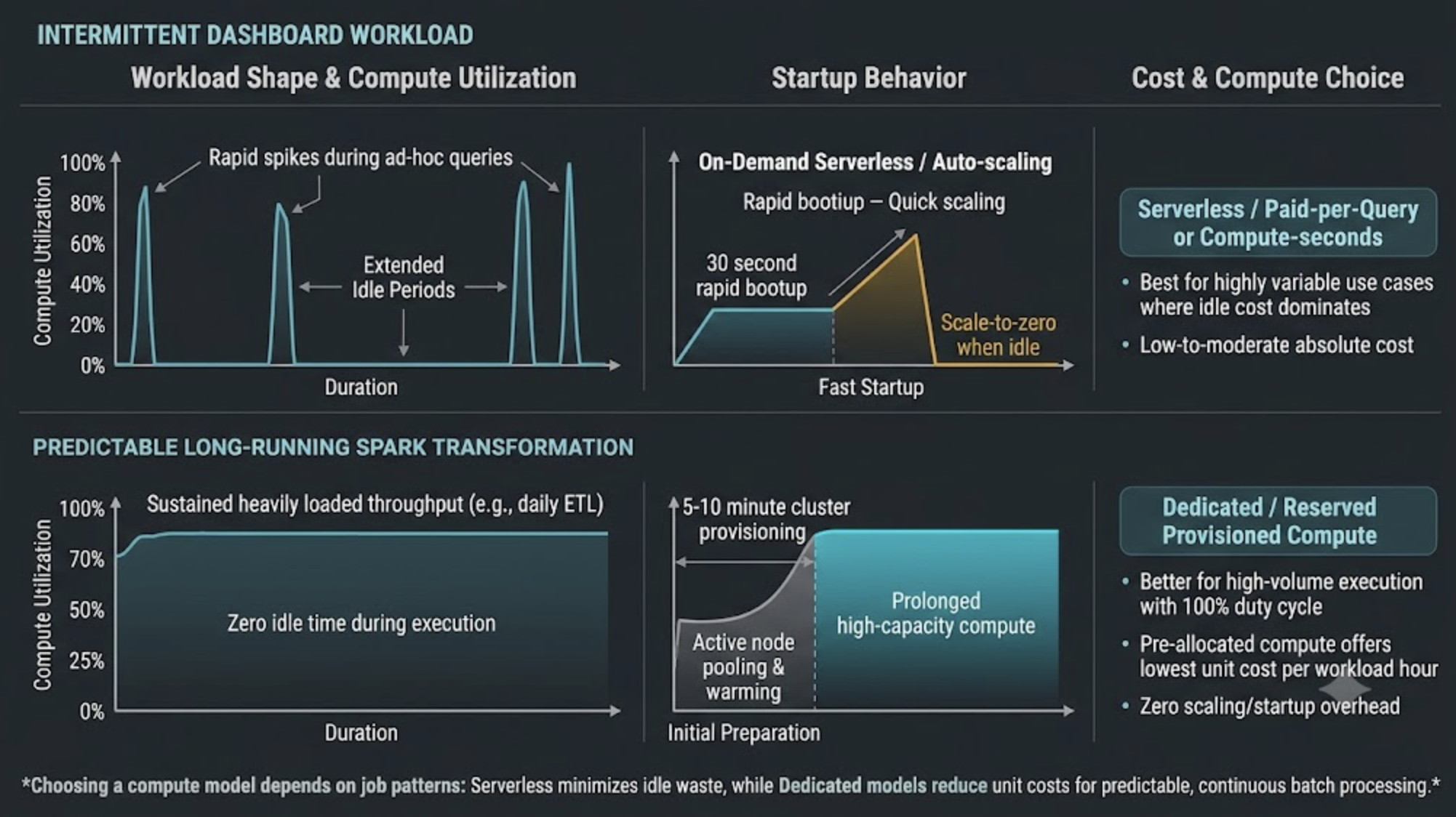
Consider two workloads.
Workload A: A dashboard experiences unpredictable bursts of queries throughout the day. Capacity sits underutilized during quiet periods.
Workload B: A high-volume transformation runs for many hours daily with predictable resource needs and carefully tuned Spark execution.
Workload A may benefit significantly from managed, elastic capacity. Workload B deserves a measured comparison against its existing compute model, including runtime, startup behavior, utilization, and billing.
The cost decision should include:
- Compute consumption and the billing model.
- Startup and idle behavior.
- Query and job duration.
- Concurrency and queueing.
- Operational overhead.
- Feature compatibility, network requirements, and governance constraints.
I would benchmark representative workloads before migrating. Compare total cost per successful output—not just the cost of one run.
For example, if a pipeline costs less per execution but fails more often and requires manual recovery, its effective cost may be higher. Likewise, a faster run that consumes significantly more compute may not be an optimization at all.
Performance tuning still matters
New platform capabilities do not eliminate the fundamentals of Spark engineering.
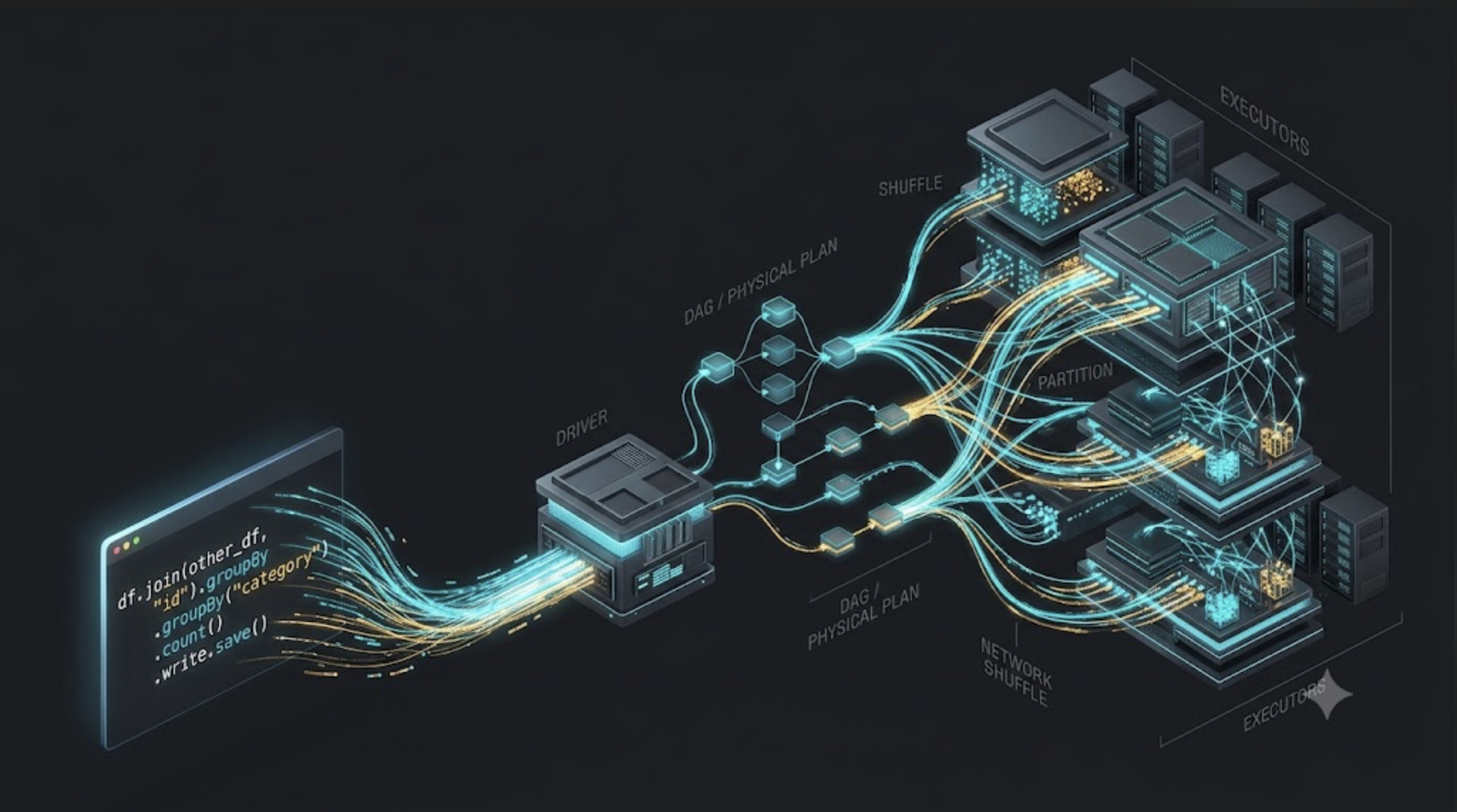
Before scaling compute, I would inspect the query plan, shuffle volume, partition sizes, skew, file layout, data pruning, and join strategy. I would look at whether the workload is I/O-bound, CPU-bound, memory-bound, or spending too much time on scheduling and small files.
A job that joins a massive fact table to a poorly filtered dimension may not need a bigger cluster. It may need a better query plan.
A table with thousands of tiny files may need a file-layout strategy. A skewed key may need a different join approach. An expensive dashboard may need fewer repeated scans or a better aggregation model.
Features such as predictive optimization and liquid clustering can help automate or improve aspects of table maintenance and data layout where supported. But they should be evaluated against the access patterns, table characteristics, and workload behavior—not enabled as a substitute for understanding the data.
My principle: Automate repetitive optimization where the platform can make good decisions. Keep engineers responsible for understanding why the workload is expensive.
5. AI/BI and Genie: can business users finally stop waiting for SQL?
Now let's look at the feature category getting the most attention: AI-assisted analytics.
A business user asks:
“Which tokens drove the highest trading volume this week, and how did that compare with the previous week?”
Today, the answer might require a request to an analyst, a SQL query, a dashboard change, or a small investigation into which metric definition is correct.
Databricks AI/BI and Genie aim to make analytics more accessible through dashboards and natural-language interaction with governed data. Databricks continues to update these capabilities, so exact availability and functionality can change over time. AI/BI and Genie release notes
The appeal is obvious: users can explore data without needing to know every table name or write every query themselves.
But here's the part that matters to a Staff Engineer.
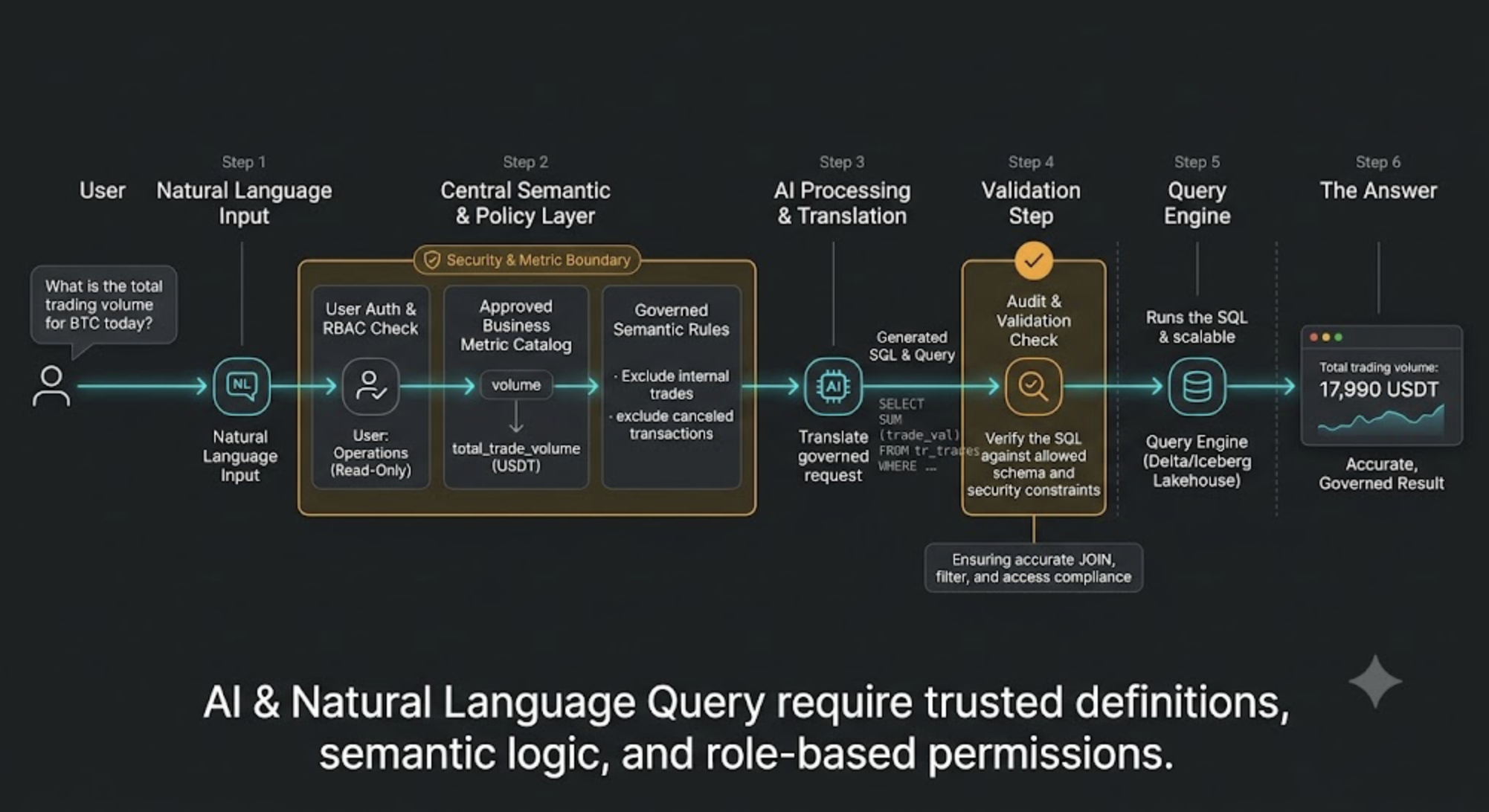
Natural language is an interface. It is not a guarantee of correct business logic.
If “trading volume” means executed notional value to Finance, token quantity to Product, and settled volume to Operations, the AI assistant needs enough governed context to distinguish them.
Without that context, a system can generate plausible SQL that answers a different question from the one the user intended. The result may look professional, contain a beautiful chart, and be completely wrong.
What makes a Genie-style experience trustworthy?
First, define the business metrics clearly. Document the intended calculation, filters, grain, and time semantics. Use certified or governed datasets where appropriate.
Second, restrict the data the user can access. A conversational interface must respect the same permissions and sensitive-data controls as other query paths.
Third, evaluate the system with real questions. Build a benchmark set containing common business questions, ambiguous questions, edge cases, and questions that should be rejected or clarified.
For example:
| Business question | What the platform should demonstrate |
|---|---|
| “Show weekly trading volume” | Uses the agreed metric and week definition |
| “Compare this week with last week” | Applies consistent time windows and comparison logic |
| “Show customer-level trading activity” | Respects the user's authorization |
| “Calculate revenue” when multiple definitions exist | Uses a documented definition or asks for clarification |
This is where I would invest engineering effort: not merely enabling the assistant, but making its answers measurable and auditable.
Track answer correctness, SQL execution success, metric consistency, access-control behavior, and the questions users cannot answer reliably.
A conversational analytics system should earn trust in the same way as any other production system.
Should you adopt it?
If analysts spend a large amount of time answering repetitive questions over well-defined datasets, the potential value is substantial.
If your business definitions are inconsistent, your catalog is poorly maintained, and your access model is unclear, an AI interface may expose those problems faster—but it won't solve them for you.
Fix the foundation, then make it easier to use.
6. AI-assisted engineering: let the assistant write code, not make the architecture decision
Databricks has also been moving toward AI-assisted development and operations. Genie Code is integrated into more of the Lakeflow experience, while Lakeflow Designer provides a visual, AI-assisted approach to building data transformations. Databricks describes Designer as generally available in its June 2026 announcement; always verify availability for your workspace and cloud. Lakeflow's 2026 direction
This is genuinely useful when applied to the right work.
Imagine a new engineer needs to create a transformation, add a quality check, or understand why a pipeline dependency is failing. An assistant with relevant code, pipeline, and data context may help accelerate the investigation.
But AI-generated code can still introduce a bad join, an incorrect null-handling rule, a costly shuffle, or a subtle business-logic regression.

The risk is not that the assistant writes code quickly. The risk is that the team starts reviewing it less carefully because it looks convincing.
I would use AI assistance for first drafts, code navigation, test scaffolding, documentation, and bounded debugging tasks. I would still require code review, automated tests, permission checks, and production observability.
For a financial data pipeline, I would specifically test duplicate events, late arrivals, schema changes, nulls, decimal precision, idempotency, and replay behavior.
An AI assistant can help write those tests. It should not be the only thing deciding whether the tests are sufficient.
The Staff Engineer's role is shifting from writing every line of code toward defining constraints, validating behavior, reviewing trade-offs, and designing systems that remain safe when generated code is imperfect.
That's not less engineering. It's engineering at a different level.
7. The architecture: how the pieces fit together
Let's put the decisions into one realistic architecture.
We want a platform that supports streaming events, reliable historical data, governed business metrics, operational monitoring, and analytics. We also want to preserve existing components where they provide genuine value.
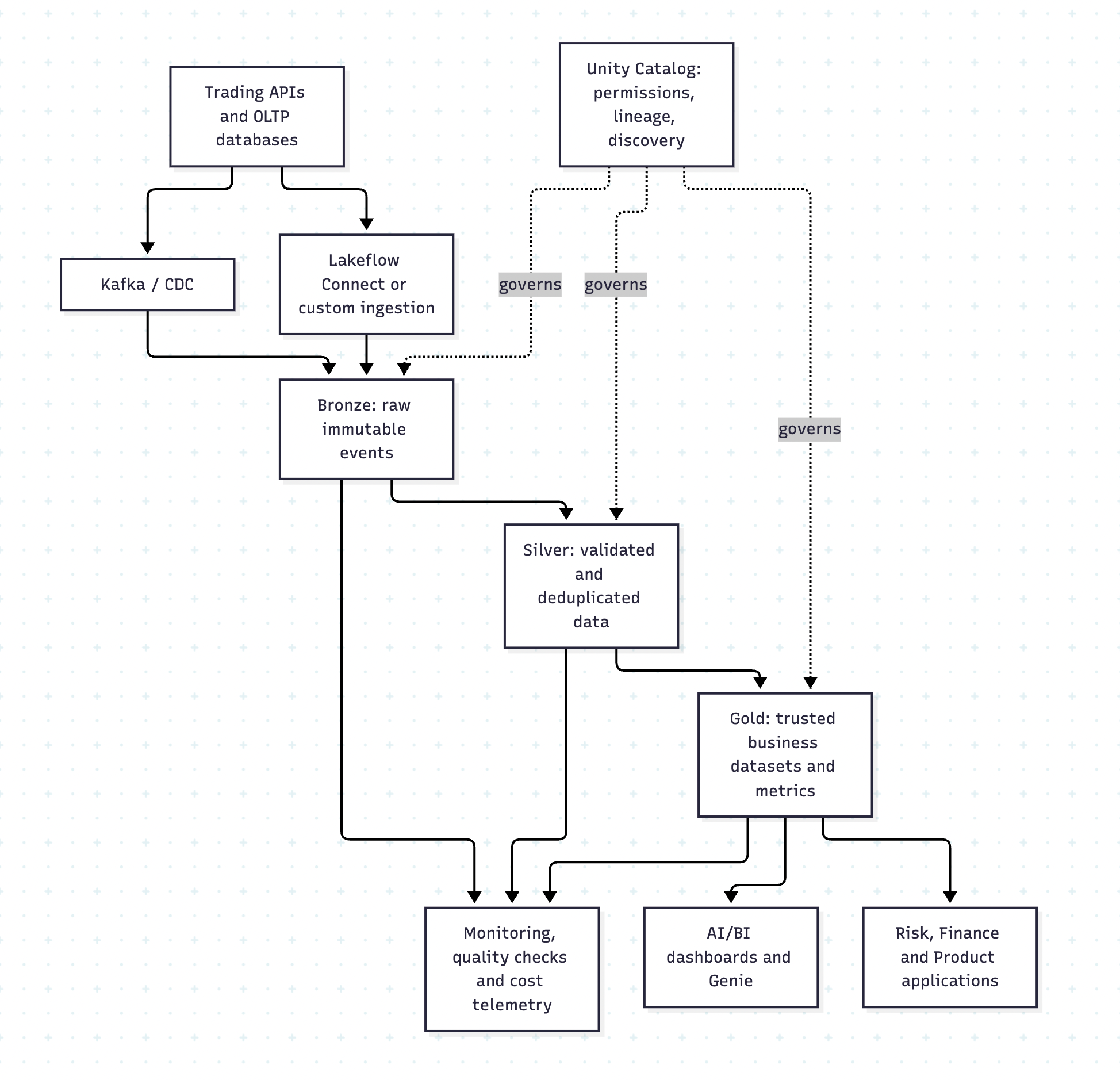
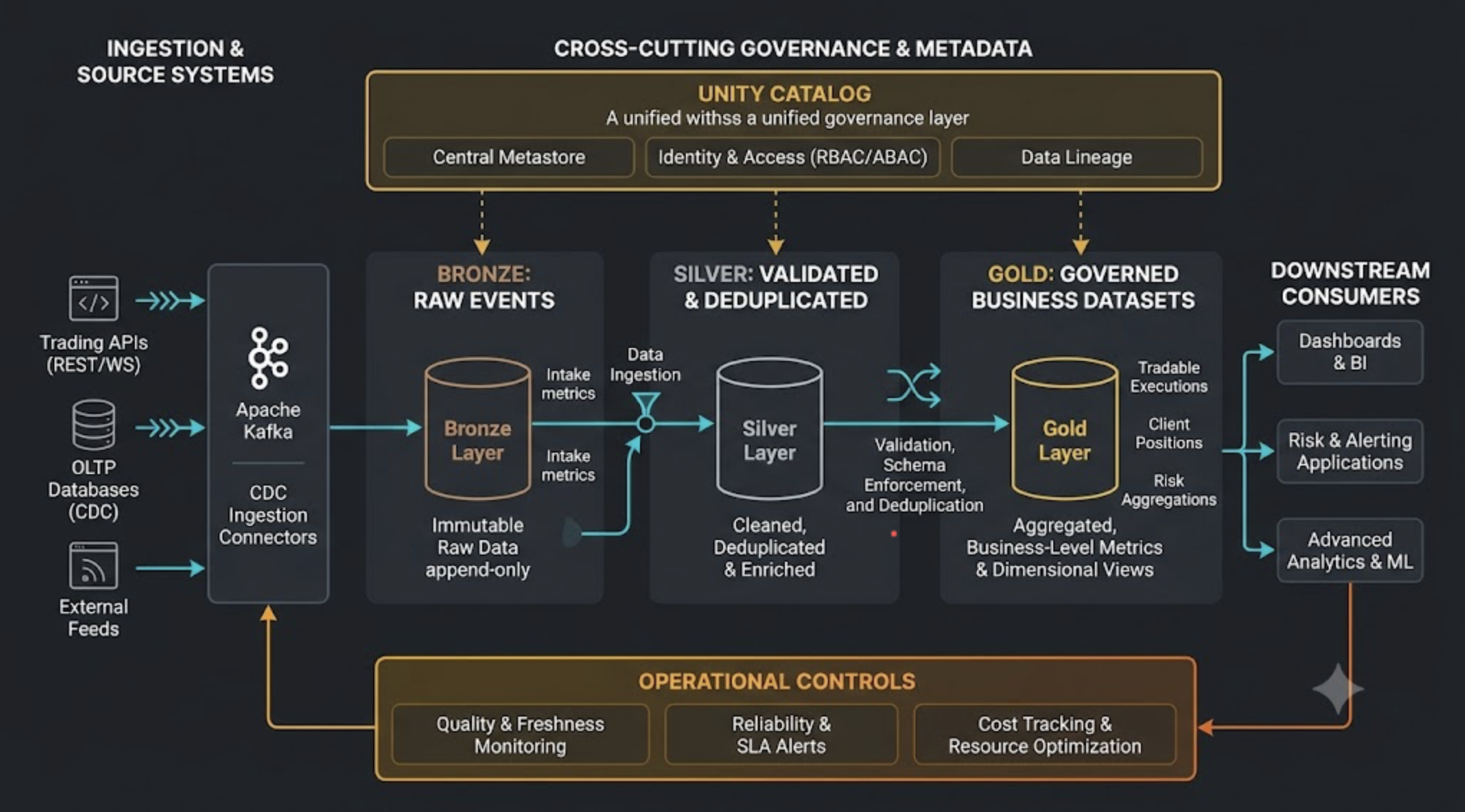
The diagram below is an example architecture, not a requirement to adopt every Databricks feature.
Walking through the data flow
Ingestion: Trading events arrive through Kafka, while supported business sources may use Lakeflow Connect. Existing CDC pipelines can remain where they meet the requirements. We do not introduce another ingestion path unless it solves a real problem.
Bronze: Preserve the source data with enough metadata to support replay and investigation. Retaining raw data does not mean retaining everything forever; lifecycle policies, privacy requirements, and storage costs still matter.
Silver: Validate schemas, normalize timestamps, apply deduplication, and handle late or malformed events according to explicit rules. This is where we establish data correctness.
Gold: Publish business-ready datasets with documented definitions. Revenue and trading volume should not acquire a different meaning in every downstream dashboard.
Governance: Unity Catalog provides a shared place for supported permissions, discovery, lineage, and other governance capabilities. Verify the enforcement behavior for each engine and access path, especially when data is consumed outside Databricks.
Consumption: AI/BI dashboards, Genie-style experiences, SQL, and downstream applications can consume approved datasets. They should not each reinvent core business definitions.
Operations: Measure freshness, failures, data quality, query performance, and cost. A green job status is not sufficient evidence that the business received correct data on time.
Notice what is absent: a mandatory migration of every workload to every new feature.
A mature architecture is not the one with the most boxes. It's the one where each box has a reason to exist.
8. A Staff Engineer's decision framework: what should you adopt first?
When evaluating new platform features, I prefer a problem-first approach over a release-note-first approach.
Start with the business or operational pain. Establish a baseline, define what improvement would look like, and test the smallest meaningful change.
| Problem you're trying to solve | Capability worth evaluating | Evidence to collect before committing |
|---|---|---|
| Too much custom ingestion and orchestration code | Lakeflow Connect, Declarative Pipelines, and Jobs | Engineering effort, failure recovery, observability, total cost |
| Inconsistent metrics and fragmented permissions | Unity Catalog governance and governed metrics | Definition reuse, access enforcement, lineage, auditability |
| Data arrives too late for decisions | Streaming or supported real-time capabilities | End-to-end freshness, correctness, throughput, recovery |
| Compute is expensive or operationally burdensome | Serverless and automated optimization capabilities | Cost per successful output, runtime, compatibility, utilization |
| Analysts depend on engineers for repetitive questions | AI/BI and Genie | Answer accuracy, permission behavior, adoption, metric consistency |
| Engineers spend too much time on repetitive coding and debugging | Genie Code and related development assistance | Review time, defect rate, test coverage, deployment safety |
The important word is evidence.
Before adopting a feature, I want to know the current state. If we cannot explain what is slow, expensive, unreliable, or confusing today, we will struggle to prove that the change made it better tomorrow.
My rollout sequence
I would begin with the area where the pain is most measurable. For example, if the team spends substantial time maintaining ingestion code, pilot a supported connector on a non-critical source. If metric inconsistency is the main problem, standardize one important business metric before enabling conversational analytics across the platform.
Then compare the old and new approaches using the same workload and success criteria. Include failure scenarios, not just the happy path.
Finally, document the decision and its boundaries. Which workloads should use this capability? Which should not? What happens when it fails? How do we roll back? Who owns the ongoing cost?
That final part is where many otherwise successful pilots fall short. A feature is not production-ready merely because the demo worked.
9. What I'd ask before approving the migration
If I were reviewing a proposal to adopt a new Databricks feature, these are the questions I'd want answered.
What specific problem are we solving? “It's the latest feature” is not a business case.
What happens if we do nothing? Sometimes the current system is imperfect but sufficiently reliable. The cost and risk of migration may exceed the benefit.
What are the new failure modes? Managed services reduce some operational work, but they may introduce new dependencies, configuration limits, or recovery procedures.
How will we measure success? Define latency, reliability, cost, engineering effort, or answer accuracy before the pilot begins.
What is the rollback strategy? A production change should have a credible exit path, especially when it affects ingestion, governance, or financial metrics.
Which capabilities are generally available in our environment? Confirm the cloud, region, runtime, permissions, and feature maturity. A public-preview capability may be worth piloting, but it should not silently become a critical dependency without an explicit risk decision.
Are we improving the whole system? A faster transformation does not help if ingestion is the bottleneck. A governed catalog does not protect data if another access path bypasses the controls. An AI assistant does not improve trust if the underlying definitions are wrong.
The system is the unit of engineering—not the feature.
10. The bigger shift: the Staff Engineer's job is to manage trade-offs
The most important Databricks developments are not necessarily the ones with the most exciting demos.
Lakeflow matters when it reduces the burden of building and operating data pipelines. Unity Catalog matters when it helps teams share data and enforce governance consistently. Real-time processing matters when fresher information changes a decision. Serverless matters when its operational and economic trade-offs fit the workload. AI-assisted analytics matters when people can obtain useful answers without sacrificing correctness or security.
Each capability is valuable in the right context. None removes the need for engineering judgment.
And that is the point.
At Staff Engineer level, the job is not to be the person who knows every new product name. It is to understand how the capabilities change the architecture, what new risks they introduce, and whether the resulting system is more trustworthy, efficient, and dependable.
Sometimes the right decision is to adopt a new capability.
Sometimes it is to improve the existing pipeline, fix the data model, or write the missing quality test.
And sometimes the most senior engineering decision is to say, “We don't need this yet.”
A surprisingly underrated feature.
The best data platform isn't the one that adopts every new feature first. It's the one that knows exactly which problems are worth solving—and can prove that the solution made things better.
Because in production, architecture diagrams don't get paged at 2 AM.
The engineers who designed them do.
#Databricks #DataEngineering #StaffEngineer #DataArchitecture #ApacheSpark #Lakehouse #DataPlatform #EngineeringLeadership
About the author
- I am a Lead Data Infrastructure Architect with 13+ years of experience engineering high-throughput data platforms for fintech and consumer apps. I specialize in the Databricks Lakehouse ecosystem, PySpark, BigQuery, and Snowflake. I write about modern data architecture, cloud cost optimization (FinOps), declarative ELT pipelines, and scaling systems to process 100K+ events per second. When I'm not untangling complex legacy databases, I'm building zero-loss data quality frameworks.
Comments
Join the discussionNo comments yet. Be the first to comment.